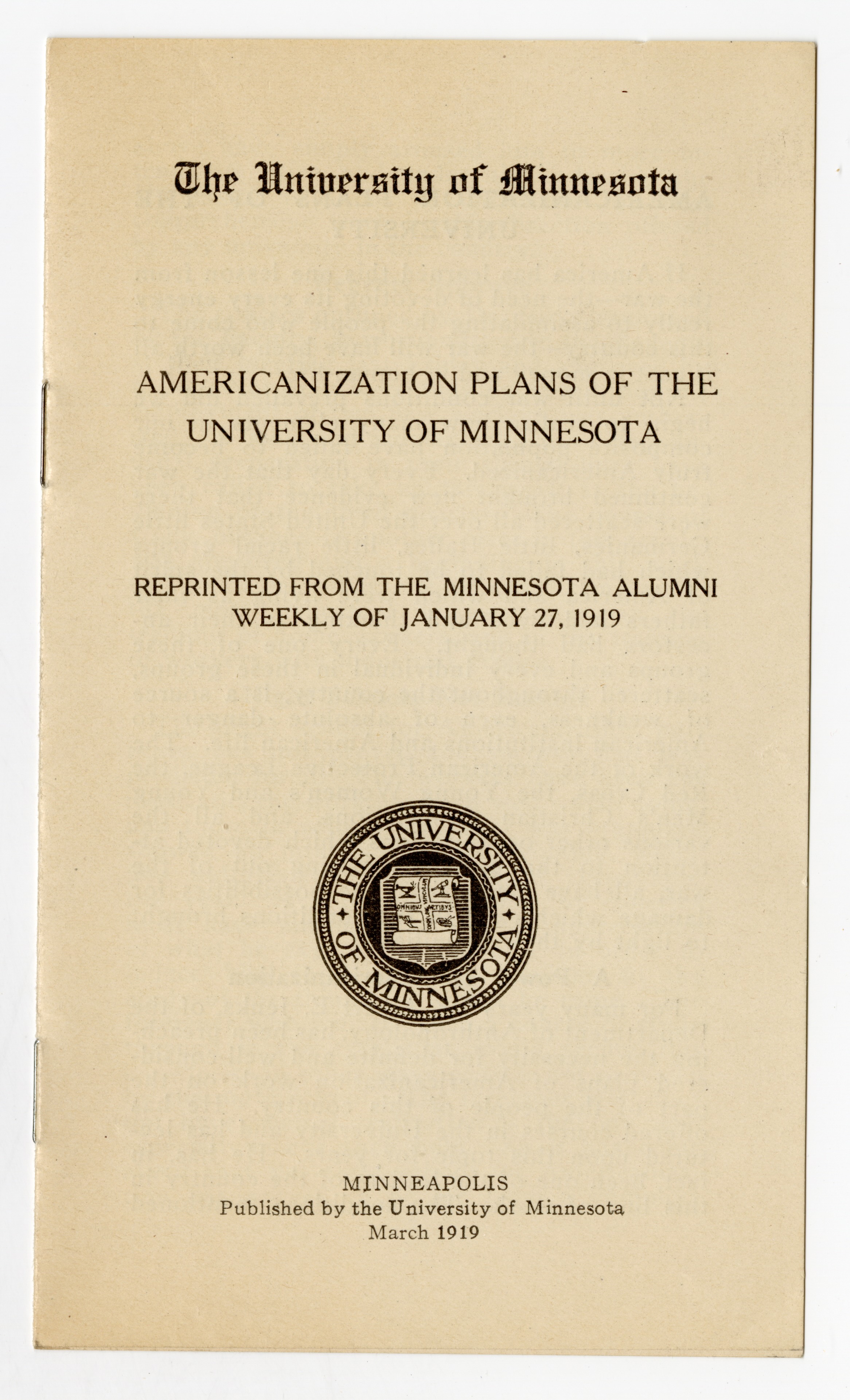
Americanization Plans of the University of Minnesota, 1919 January 27
1 media/nmmn_00202_thumb.jpg 2024-10-03T19:34:30+00:00 Kristina Warner c8c3eeb8fc534b4204fc4ece92574ef9ee4ab6bd 6 1 Pamphlet Collection (P0436) plain 2024-10-03T19:34:30+00:00 20241002 155219-0500 Kristina Warner c8c3eeb8fc534b4204fc4ece92574ef9ee4ab6bdThis page is referenced by:
-
1
media/p0665_00009.jpg
2024-03-26T16:46:26+00:00
Anti-foreign Animus and Americanization
9
plain
2024-10-04T20:12:13+00:00
The Hyphenated Americans
World War I sparked a nativist movement against hyphenated Americans, or Americans who came from other countries, as immigrant groups were seen as separate from America and not fully supportive. According to MNopedia, “The growing tension between heritage and assimilation came to a head when America entered World War I. In the 1890s, nativist rhetoric from politicians like Massachusetts’ Henry Cabot Lodge had urged Americans to preserve the hegemony of Protestant Anglo-Saxons against millions of new immigrants. It reappeared in the 1910s, strengthened by fears of political radicals and German saboteurs."Americanization
Those who continued to practice their European heritage found themselves under attack from fellow Americans, as a wave of nationalism had gripped the nation and anything associated with Europe was in question. Despite Norway’s neutrality, this applied to Norwegian Americans as well. Norwegians, like Germans and others of European nationality, found themselves at the receiving end of a brutal campaign of Americanization. Newspapers published in Norwegian were censored. Governor Harding of Iowa forbade the use of any foreign language in any public place in Iowa, and other governors in other states did similar things.
In the mind of many Americans, speaking a foreign language or practicing a foreign culture was seen as anti-American, or as a sign that someone didn’t support America. As a result, fluency in Norwegian among Norwegian American children dropped dramatically. Norwegian-Americans' support for joining World War I was also called into question as only four of the ten “Norwegian” votes in Congress supported Woodrow Wilson’s 1917 declaration of war. America’s entry into World War I only heightened the nationalism amongst Americans.Assimilation: The Melting Pot
As a result of the extreme pressure from fellow Americans, Norwegian Americans were forced to assimilate more quickly into American culture and drop their status as Norwegian Americans. Many Norwegian newspapers, schools, and churches began switching from Norwegian to English, and the Norwegian Lutheran Church officially became just the Lutheran Church.
“At the time of the [1914] Eidsvoll festival, asserts [Carl] Chrislock, ‘very few observers were predicting that assimilation would shortly obliterate the Norwegian-American community.’ It was World War I that helped slow ethnic activism, and after the outbreak of the war, ‘festival rhetoric became considerably more prone to acknowledge the claims of American patriotism.’ For Chrislock the 1925 centennial was merely ‘a last hurrah’ - the end of Norwegian-American history” (Schultz, p. 273).
Immigration has always been a big part of United States history. In 1890, 14.8 percent of the population were immigrants. In 2019, immigrants comprised 13.7 percent of the total U.S. population. Norwegian immigrants started arriving in the United States in 1825, by the 1890 census there were around 300,000 Norwegian immigrants, and in the 1910 census, there were 493,877 immigrants residing in the U.S.
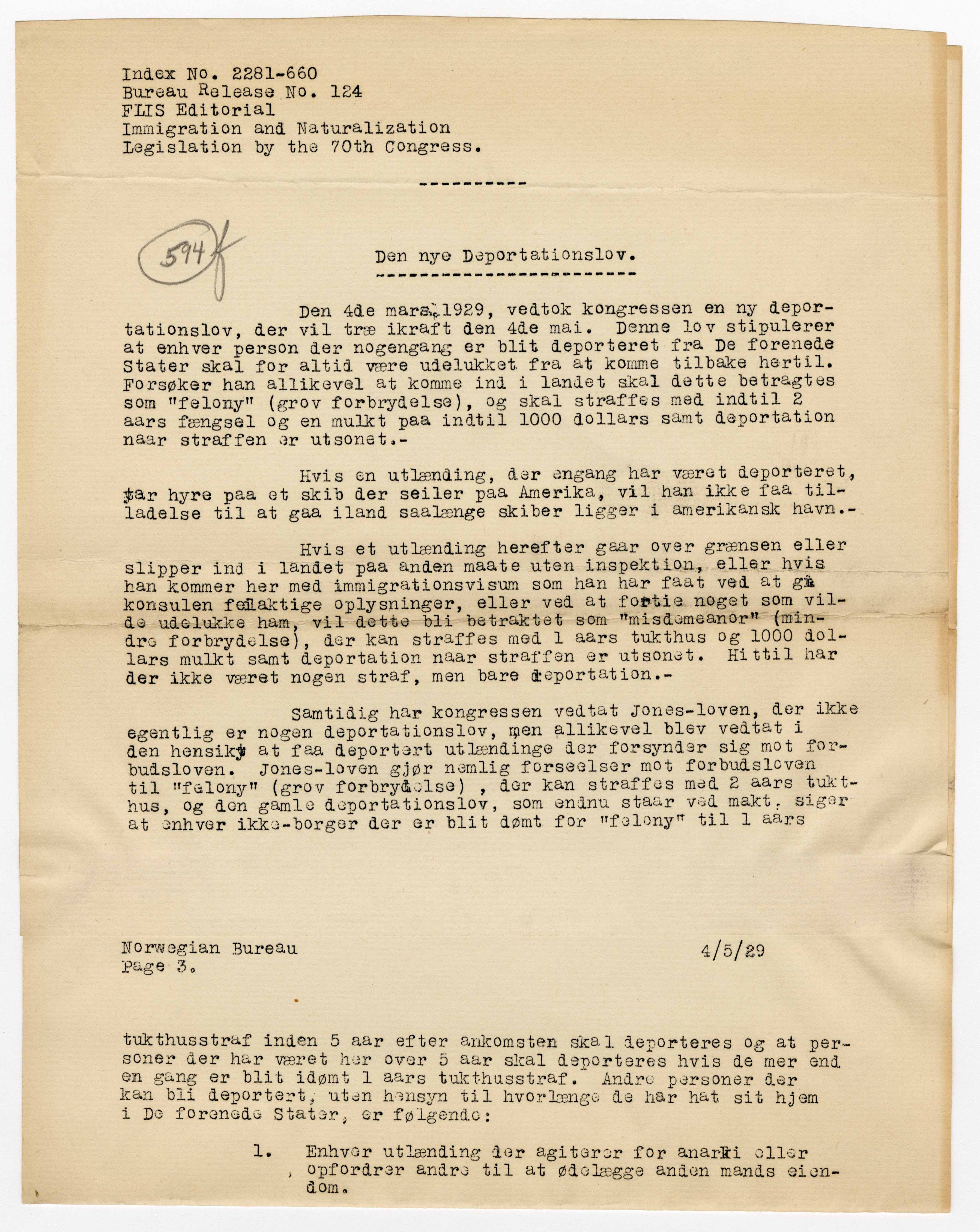
Despite the importance of immigration, the number of immigrants allowed into the United States was actively limited during and after World War I. However, there were already strict immigration laws before these bills, including the Chinese Exclusion Act of 1882. During this period, the three main immigration bills were the Immigration Act of 1917, the Emergency Immigration Act of 1921, and the Immigration Act of 1924.Interpreting the Immigration Acts
The Immigration Act of 1917 (Barred Zone Act) bill severely limited who was able to immigrate to the United States. Those forbidden to enter included contract laborers (those who already had found work in the United States), those whose tickets were paid for by someone else, polygamists, anarchists, unaccompanied children under 16, and all native descendants from Asian countries (unless occupied by the United States) among many others. Another section of this bill focuses on “illiterates” and forbidding them to enter, which introduced a literacy test to immigrate.
The Emergency Immigration Act of 1921 limited immigration to, “... 3 per centum of the number of foreign-born persons of such nationality resident in the United States …” This data was determined by the 1910 census, and no more than 20% of the limit could be reached a month. This bill further restricted immigration and severely limited the number of immigrants entering the United States.
The Immigration Act of 1924 (Johnson-Reed Act) built upon the two previous bills and further limited the number of immigrants entering the United States. Instead of allowing 3% to enter the United States, the Immigration Act of 1924 lowered it to 2%. The minimum quota for each nationally was also 100. Instead of using the 1910 census data, the bill was based off of the 1890 census. This change was designed and favored by eugenicists, as eugenicists wanted to limit the amount of non-white, non-northern European immigrants. The change from using the 1910 census to the 1890 census heavily favored white, northern European immigrants, hence. For example, the population of immigrants from Italy in the 1910 census was 1,343,125. However, in the 1890 census, the population of immigrants from Italy was just under 200,000.